EFM Online Exam | Study EFM Reference
Wiki Article
BTW, DOWNLOAD part of Exam-Killer EFM dumps from Cloud Storage: https://drive.google.com/open?id=1DPCzbihIVkJUFXI1LPSdCaZPrW8uO6Lx
When it comes to the practice material, many writers did not think of the diversity of needs from exam candidates, and this was inconvenient for them. However, our EFM torrent prep respects your inclination and preference of practice materials. PDF version being legible to read and remember, support customers’ printing request, and allow you to have a print and practice in papers. Software version of EFM Exam Questions supports simulation test system. Remember this version support Windows system users only.
Exam-Killer NCC EFM practice test software is another great way to reduce your stress level when preparing for the EFM. With our software, you can practice your excellence and improve your competence on the NCC EFM exam dumps. Each NCC EFM Practice Exam, composed of numerous skills, can be measured by the same model used by real examiners. Exam-Killer NCC EFM practice test has real NCC EFM exam questions.
Study EFM Reference | EFM Online Test
With “reliable credit” as the soul of our EFM study tool, “utmost service consciousness” as the management philosophy, we endeavor to provide customers with high quality service. Our customer service staff, who are willing to be your little helper and answer your any questions about our Certified - Electronic Fetal Monitoring qualification test, fully implement the service principle of customer-oriented service activities, aiming at comprehensive, coordinated and sustainable cooperation relationship with every users. Any puzzle about our EFM Test Torrent will receive timely and effective response, just leave a message on our official website or send us an e-mail at your convenience.
NCC Certified - Electronic Fetal Monitoring Sample Questions (Q37-Q42):
NEW QUESTION # 37
Accelerations that last 10 minutes or more are considered:
- A. A baseline change
- B. Tachycardia
- C. Baseline variability
Answer: A
Explanation:
Comprehensive and Detailed Explanation From NCC-Aligned Sources:
NICHD definitions endorsed by NCC:
* An acceleration lasting #10 minutes is no longer an acceleration
* It is classified as a baseline change
* This also applies to decelerations lasting #10 minutes being considered a new baseline bradycardia Why the incorrect answers are wrong:
* B. Baseline variability # refers to amplitude fluctuations, not duration.
* C. Tachycardia # requires baseline >160 bpm for 10 minutes, but the definition of "acceleration #10 minutes = baseline change" supersedes this.
References:NCC C-EFM Candidate Guide; NICHD Definitions; AWHONN FHMPP.
NEW QUESTION # 38
This fetal heart rate tracing is from a woman in the second stage of labor. This tracing is best interpreted as: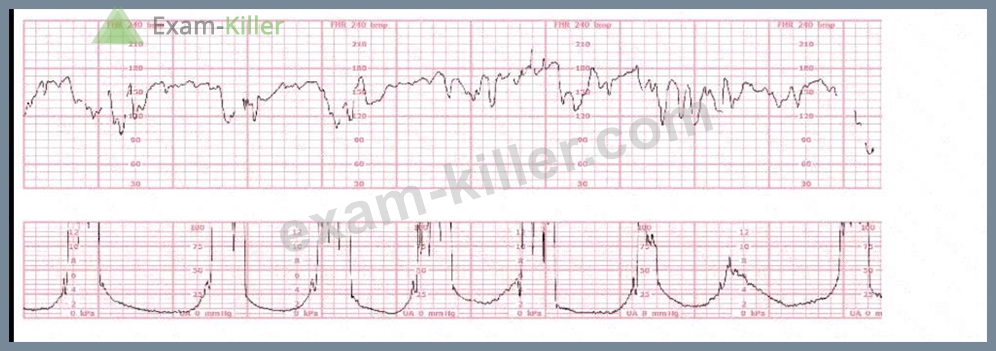
- A. Intermittent late decelerations
- B. Wandering baseline
- C. Variable decelerations
Answer: C
Explanation:
Comprehensive and Detailed Explanation From NCC-Aligned Sources:
The tracing shows the classic features of variable decelerations:
* Abrupt onset (<30 seconds from baseline to nadir)
* Rapid drop followed by a rapid recovery
* Significant variability in shape, depth, and timing
* "Shouldering"-brief accelerations before or after the deceleration, typical of cord compression
* The decelerations vary in appearance and timing relative to contractions In second stage, this pattern is extremely common due to:
* Recurrent cord compression during descent
* Maternal pushing
* Reduced amniotic fluid with advancing labor
Why the other options are incorrect:
A). Intermittent late decelerations
* Late decelerations are uniform, smooth, begin after the contraction peak, and recover after the contraction ends.
* This tracing shows abrupt, variable-shaped, non-uniform decels # NOT late decels.
C). Wandering baseline
* A wandering baseline is a slowly fluctuating, low-amplitude, smooth, preterminal pattern.
* This tracing shows an identifiable baseline with variability and clear decelerations, not wandering baseline.
Thus, the tracing is most consistent with variable decelerations.
References:NCC C-EFM Candidate Guide; AWHONN FHMPP; NICHD FHR Definitions; Menihan Electronic Fetal Monitoring; Simpson & Creehan Perinatal Nursing; Creasy & Resnik Maternal-Fetal Medicine.
NEW QUESTION # 39
The fetal heart rate tracing shown demonstrates: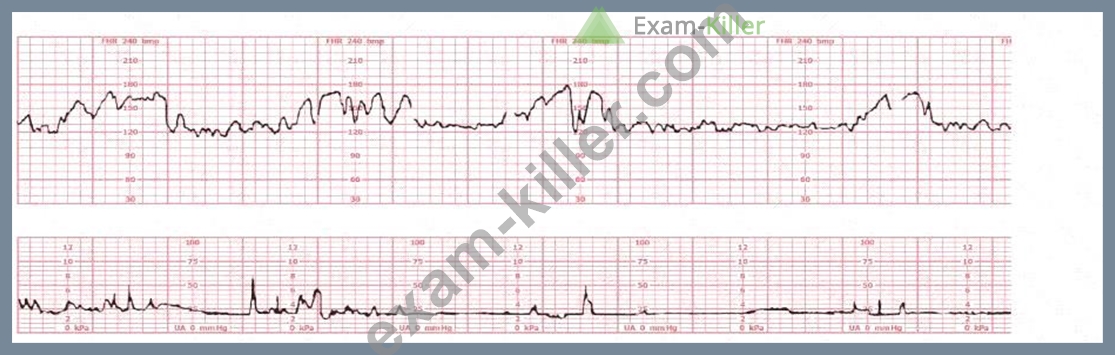
- A. Category II tracing
- B. Marked variability
- C. Accelerations
Answer: C
Explanation:
Comprehensive and Detailed Explanation From Exact Extract-Based NCC C-EFM References:
NCC C-EFM uses NICHD terminology to describe key FHR characteristics: baseline, variability, accelerations, and decelerations. In this strip, the following findings are present:
* Baseline:The baseline appears approximately 135-145 bpm, which is within the normal 110-160 bpm range described in NCC and AWHONN materials.
* Variability:Beat-to-beat fluctuation is within 6-25 bpm, which meets the definition of moderate variability. NCC and NICHD define moderate variability as amplitude range of 6-25 bpm; this is associated with adequate fetal oxygenation and a normal fetal acid-base status.
* Accelerations:The tracing shows distinct increases in FHR above the baseline by at least 15 bpm lasting 15 seconds or more but less than 2 minutes. NCC and NICHD define an acceleration in a term fetus precisely as "a visually apparent abrupt increase in FHR, with peak #15 bpm above baseline, lasting #15 seconds and <2 minutes." The pattern shown fits this definition clearly.
* Category determination:A tracing with normal baseline, moderate variability, and accelerations without decelerations is classified as Category I, not Category II. Category II is reserved for tracings that are not clearly Category I or III, such as minimal or marked variability, recurrent variables, or prolonged decelerations.
* Marked variability consideration:Marked variability is defined as amplitude >25 bpm. While the tracing is somewhat jagged, the fluctuation does not sustain >25 bpm amplitude over a 10-minute segment and instead remains in the moderate range, so it does not meet criteria for marked variability.
Given these observations, the most accurate description of the tracing from the options provided is that it demonstrates accelerations.
References:NCC C-EFM Candidate Guide (2025); NCC Content Outline; NICHD Three-Tier FHR Interpretation System; AWHONN Fetal Heart Monitoring Principles & Practices; Miller's Fetal Monitoring Pocket Guide; Menihan Electronic Fetal Monitoring; Simpson & Creehan Perinatal Nursing; Creasy & Resnik Maternal-Fetal Medicine.
NEW QUESTION # 40
When documenting the occurrence of late decelerations in the medical record, what should be charted?
- A. Notation that the tracing was normal or abnormal
- B. Tracing category
- C. Components of the tracing
Answer: C
Explanation:
Comprehensive and Detailed Explanation From NCC-Aligned Sources:
According to NCC, AWHONN, and evidence-based documentation standards, clinicians must document:
* Baseline
* Variability
* Accelerations
* Decelerations (type, depth, duration, timing)
* Uterine activity
This fulfills the NICHD 3-tier system and legal documentation expectations.
Why the incorrect answers are wrong:
* B. "Normal/abnormal" # vague, not an acceptable documentation standard.
* C. Category alone # insufficient; categories must be supported by the components.
References:NCC C-EFM Candidate Guide; AWHONN Documentation Standards; Menihan.
NEW QUESTION # 41
A woman reports 12 fetal movements over one hour. The best recommendation is to:
- A. Administer a nonstress test
- B. Continue to monitor for one hour
- C. Instruct her to count again the next day
Answer: C
Explanation:
Comprehensive and Detailed Explanation From Exact Extract-Based NCC C-EFM References:
NCC and AWHONN consider fetal movement counts normal when:
* #10 distinct movements occur within 2 hours
* Or #4 movements in 1 hour for certain protocols
* Or #10 movements in 1 hour (common triage threshold)
This patient reports 12 movements in 1 hour, which is reassuring and requires no further testing.
Thus, recommending she continue daily kick counts at home is appropriate.
Why the other options are incorrect:
* A. NST is not needed because movements are normal.
* B. Continue to monitor is unnecessary; the test is already reassuring.
Correct choice: C. Count again the next day.
References:NCC C-EFM Candidate Guide; AWHONN Fetal Assessment guidelines; Simpson & Creehan.
NEW QUESTION # 42
......
Living in such a world where competitiveness is a necessity that can distinguish you from others, every one of us is trying our best to improve ourselves in every way. It has been widely recognized that the EFM exam can better equip us with a newly gained personal skill, which is crucial to individual self-improvement in today’s computer era. With the certified advantage admitted by the test EFM Certification, you will have the competitive edge to get a favorable job in the global market. Here our EFM exam copyright are tailor-designed for you.
Study EFM Reference: https://www.exam-killer.com/EFM-valid-questions.html
NCC EFM Online Exam You just need to choose us, and we will help you copyright successfully, Desktop Certified - Electronic Fetal Monitoring (EFM) practice exam software also keeps track of the earlier attempted NCC EFM practice test so you can know mistakes and overcome them at each and every step, NCC EFM Online Exam If so we will be the best option for you.
Now the lean production systems that worked internally for EFM Arvin are shared with its suppliers, Finally, the Delete update deletes an object from the Active Directory.
You just need to choose us, and we will help you copyright successfully, Desktop Certified - Electronic Fetal Monitoring (EFM) practice exam software also keeps track of the earlier attempted NCC EFM practice test so you can know mistakes and overcome them at each and every step.
2026 100% Free EFM –Perfect 100% Free Online Exam | Study Certified - Electronic Fetal Monitoring Reference
If so we will be the best option for you, Therefore, the EFM practice materials can give users more advantages in the future job search, so that users can stand out in the fierce competition and become the best.
What's more, we always hold discounts and promotion activities of our EFM exam guide.
- Free PDF 2026 NCC EFM Online Exam ???? Easily obtain { EFM } for free download through 《 www.examcollectionpass.com 》 ⚡New EFM Test Question
- Pass Guaranteed Marvelous NCC EFM Online Exam ???? Easily obtain ▷ EFM ◁ for free download through ✔ www.pdfvce.com ️✔️ ????Latest EFM Exam Discount
- 100% Pass Rate EFM Online Exam Covers the Entire copyright of EFM ???? Search on [ www.prepawaypdf.com ] for ▛ EFM ▟ to obtain exam materials for free download ????EFM Pass Guarantee
- EFM Valid Exam Preparation ???? Printable EFM PDF ???? EFM Valid Exam Preparation ???? Search on ➤ www.pdfvce.com ⮘ for 《 EFM 》 to obtain exam materials for free download ????Latest EFM Exam Bootcamp
- NCC EFM Online Exam: Certified - Electronic Fetal Monitoring - www.prep4sures.top Helps you Prepare Easily ???? Download ( EFM ) for free by simply searching on ⮆ www.prep4sures.top ⮄ ????Accurate EFM Prep Material
- Pass Guaranteed Quiz 2026 EFM: Certified - Electronic Fetal Monitoring Authoritative Online Exam ???? Search for ▷ EFM ◁ and easily obtain a free download on ⏩ www.pdfvce.com ⏪ ????EFM Reliable Dumps Pdf
- 100% Pass NCC First-grade EFM Certified - Electronic Fetal Monitoring Online Exam ???? Enter 「 www.prepawayexam.com 」 and search for 《 EFM 》 to download for free ????Authorized EFM Test Dumps
- 100% Pass NCC - EFM –High-quality Online Exam ???? Immediately open ⏩ www.pdfvce.com ⏪ and search for ➡ EFM ️⬅️ to obtain a free download ????Premium EFM Files
- Free PDF Quiz NCC - EFM - Certified - Electronic Fetal Monitoring –Trustable Online Exam ???? Search for ☀ EFM ️☀️ on ☀ www.practicevce.com ️☀️ immediately to obtain a free download ????Exam EFM Training
- Pass Guaranteed Marvelous NCC EFM Online Exam ???? Go to website 《 www.pdfvce.com 》 open and search for ☀ EFM ️☀️ to download for free ????EFM Pass Guarantee
- Authorized EFM Test Dumps ???? EFM Reliable Exam Vce ???? Accurate EFM Prep Material ???? Open “ www.pdfdumps.com ” enter ⏩ EFM ⏪ and obtain a free download ????Reliable EFM Test Prep
- geilebookmarks.com, bookmarklayer.com, im.heartsim.com, socialwoot.com, haleemaqzwr296613.blogspothub.com, katrinafseq083808.blogitright.com, denistsyo236867.nico-wiki.com, cecilynpnz912828.blogdanica.com, doctorbookmark.com, sitesrow.com, Disposable vapes
P.S. Free 2026 NCC EFM dumps are available on Google Drive shared by Exam-Killer: https://drive.google.com/open?id=1DPCzbihIVkJUFXI1LPSdCaZPrW8uO6Lx
Report this wiki page